
Three Key Trends to Predict the 2026 Stanley Cup Champion
The 2026 Stanley Cup Finals between the Carolina Hurricanes and Vegas Golden Knights begins on Tuesday, June 2. The Hurricanes are considered to be the favourites, becoming the first team to enter the finals 12-1 since the NHL went to the 16-win playoff format in 1987. The Hurricanes also finished second in the league standings and first in the Eastern Conference with 113 points, giving them home-ice advantage.
The Golden Knights are also entering the finals with a strong record of 12-4. While during the regular season the Golden Knights became one of the weakest division winners the league has seen in the modern era as highlighted by a previous article, winning just 39 out of 82 games, there is very little carry over from that team to the playoffs, as previous head coach Bruce Cassidy was fired with just eight games remaining. Replacement head coach John Tortorella led the Knights to an immediate turnaround, as they finished the season on a 7-0-1 run and have evidently become a completely different team.
Both finalists have a legitimate case to win the Stanley Cup. It’s difficult to predict a Stanley Cup Champion based on quantitative metrics alone, as finalists will almost always have strong metrics ahead of the finals. However, there are three key qualitative metrics to predict who will win the Stanley Cup.
1 - Experience
Arguably the most important factor above all else is experience. As Wayne Gretzky once said, a full NHL season can be divided into three sub-seasons: the regular season, the first three rounds of the playoffs, and the Stanley Cup Finals. Gretzky noted that the pressure and intensity changes dramatically in each phase. The numbers would back this idea up, revealing that teams that have been to the finals before know how to handle this increased pressure and are more prepared for the finals.
By looking at instances of finals where one finalist had been to a finals at least once in the previous five years, and the opposing finalist had not been to the finals in more than five years, the team with that experience within five years had won the cup 19 out of 20 instances since 1981. For example, in 2023, the Vegas Golden Knights had last been to the finals in 2018 (five years prior) and the Florida Panthers had not been to the finals since 1996 (more than five years). So the 2023 finals qualifies for this criteria, where the Golden Knights, the more experienced team by this metric, won the Stanley Cup.
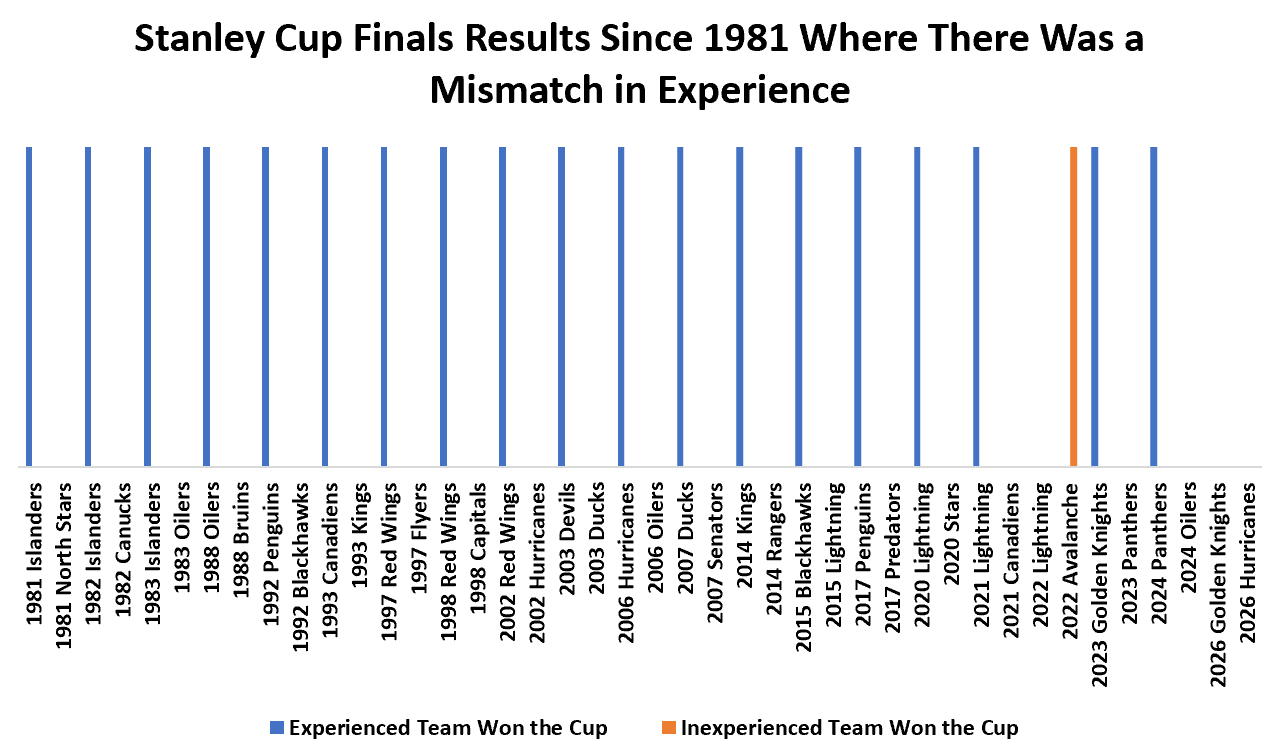
Since 1981, the 2022 Avalanche are the only finalist who had not been to a finals within the last five years that defeated an opposing finalist that had been to at least one finals in the last five years.
Of these instances, the team with more experience also happened to have home-ice advantage 16 times. The one instance where the experienced team lost to the inexperienced team was in 2022, where the experienced Lightning did not have home-ice advantage, and the Avalanche with home-ice advantage won the Stanley Cup. The 1992 Penguins, 1997 Red Wings, and 2015 Blackhawks are the three instances where experience was more important than home-ice advantage, as these three teams won the Stanley Cup despite starting the finals on the road. This means experience works better in conjunction with home-ice advantage, and perhaps for a new finalist starting on the road, the pressure of the opposing crowd for their first finals in over five years is a significant learning curve to handle. However, this will not be the case with the 2026 Stanley Cup Finals, as the Carolina Hurricanes will have home-ice advantage, which is the second major trend.
2 - Home-Ice Advantage
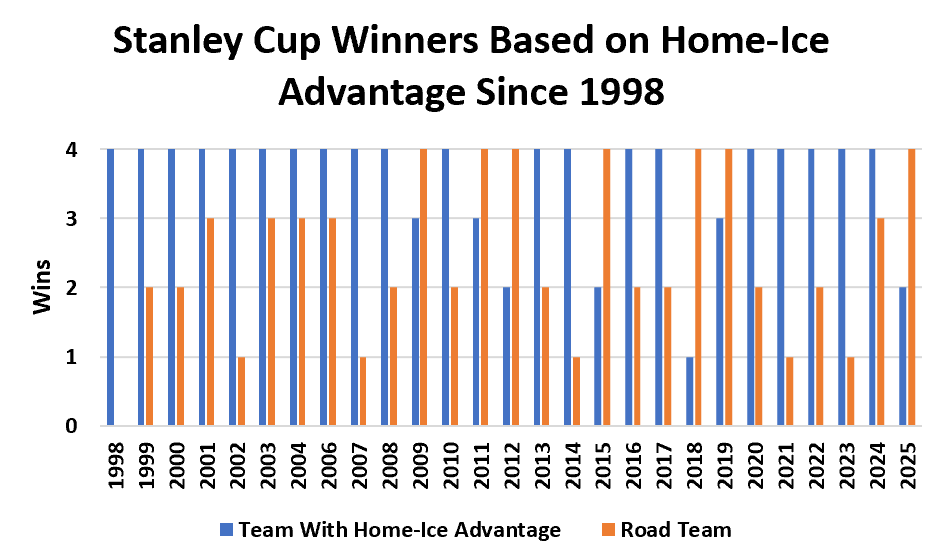
Home-ice advantage is more significant in the Stanley Cup Finals than any other round. In fact, since 1998, the finalist with home-ice advantage have won the Stanley Cup 20 out of 27 times for a win rate of 74.1%. This is above the overall home-ice advantage series win rate of just under 60% in that same time span. Why home-ice advantage has been so much more important in the finals compared to other rounds isn’t exactly known, whether it be due to the energy from the crowd, having the last change, or it simply being a confounding variable, since ultimately teams with home-ice advantage are usually the better team, hence why they finished higher in the standings. Whatever the reason is, home-ice advantage lives up to its name in the finals. In addition to 20 out of the last 27 cup winners having home-ice advantage, the 2012 L.A. Kings are the only team that began on the road that managed to go up 2-0 in the series since 1998, and both of those games required overtime. Conversely, 15 of these 27 finals saw the team with home-ice advantage going up 2-0 in the series, with only two teams down 2-0 able to come back and win the series, those being the 2009 Penguins and 2011 Bruins. This trend implies that it is very likely that the Hurricanes will be going to Vegas in game 3 at minimum tied 1-1.
3 - Rest Before the Finals
The final key trend is rest. As discussed in a recent blog post here, significant rest between series is a disadvantage, and should instead be referred to as rust. The hockey world saw this first-hand in game 1 of the 2026 Eastern Conference Finals, where the Hurricanes suffered their lone loss of the 2026 playoffs after having the most rest between a series since the 1919 Montreal Canadiens. Heading into the finals, Vegas will have had a full week in between games, whereas the Hurricanes only had three full days off. When used in conjunction with home-ice advantage, rest becomes even more significant. Since 1998, the team with less rest between the Conference Finals and Stanley Cup Finals won the cup 19 out of 27 times for a win rate of 70.4%, slightly lower than home-ice advantage. However, when paired together, when a team has both home-ice advantage and is less rested, that team won the cup in 15 out of 18 instances, for a win rate of 83.3%. The only finalists to buck this trend were the 2009 Penguins, 2012 Kings, and 2025 Panthers, but the rest difference was still only one day for the 2009 Penguins and 2025 Panthers. The 2012 Kings had three extra days off compared to the New Jersey Devils who they would defeat in the finals, and this dynamic is the same with the Golden Knights and Hurricanes, where the Golden Knights have three more days off than the Hurricanes and will be starting in Carolina.
Conclusion
Ultimately, both the Carolina Hurricanes and Vegas Golden Knights have been dominant in these finals, with a combined three sweeps between the two. There are few underlying stats that can accurately predict a winner between these two, but the Stanley Cup Finals is a round where qualitative trends usually become more prominent. The Vegas Golden Knights have the edge in experience, which has historically been a very strong predictor of which finalist will win the Stanley Cup. However, so is having home-ice advantage and simultaneously being less rested, an advantage in favor of the Carolina Hurricanes. As a result, one of these strong trends is bound to take a hit, as both teams look poised to win it all.