
Is Too Much Rest a Disadvantage in the Stanley Cup Playoffs
As the 2026 Conference Finals gets underway in the Stanley Cup Playoffs, the Carolina Hurricanes and Montreal Canadiens find themselves at complete opposite ends of the rest spectrum. The two teams will play game 1 on May 21, a whole 12 days after Carolina last played a game. This means that the Carolina Hurricanes have had 11 days of rest, the most since the Montreal Canadiens in 1919, when they went from March 6 to March 19 without playing. This extraordinarily long break was caused by a multitude of factors, starting with the fact that the Carolina Hurricanes opened the entire playoffs in game 1 of the first round against the Ottawa Senators and swept them in a weeks time. Meanwhile, the Canadiens/Lightning first round series was the only series in round 1 to go the full seven games. Because of how the schedule worked and how there would have been no games on Saturday, May 2, the biggest hockey day of the week, the NHL decided to begin the Conference Semifinals one day before game seven between Montreal and Tampa Bay, where the Carolina Hurricanes took down the Philadelphia Flyers in a 3-0 win. Montreal didn’t play game 1 of their second round series against the Buffalo Sabres until Wednesday, May 6, and the Hurricanes completed their second round sweep over the Flyers by May 9, the day before Buffalo and Montreal even played a game at the Bell Centre. Because the two teams were evenly matched, this series went the full seven, and all of these factors created a perfect storm for the longest break a team has faced in over 100 years.
All of this begs the question, is too much rest a bad thing? The short answer is it depends. The primary negative facotr of too much rest is rustiness from not playing. The Carolina Hurricanes haven’t played a playoff game in almost two weeks, something impossible to emulate in practice, while the Montreal Canadiens will still be in a rhythm having had just two days off. This momentum difference is theoretically favourable for the less rested team, as for them it is more closely tied to regular season hockey, where players are in their usual routines. The well rested team may return rusty, similar to how the first few weeks of the regular season are usually higher scoring and more “chaotic” because of the rustiness of players and systems. A factor that can be both positive and negative is injuries. While you would think rest would be helpful for healing injuries, some hockey minds have pointed out that certain injuries can nag and get worse if players aren’t moving around like they do in games. But in general, this is a factor that likely leans more positive than negative.
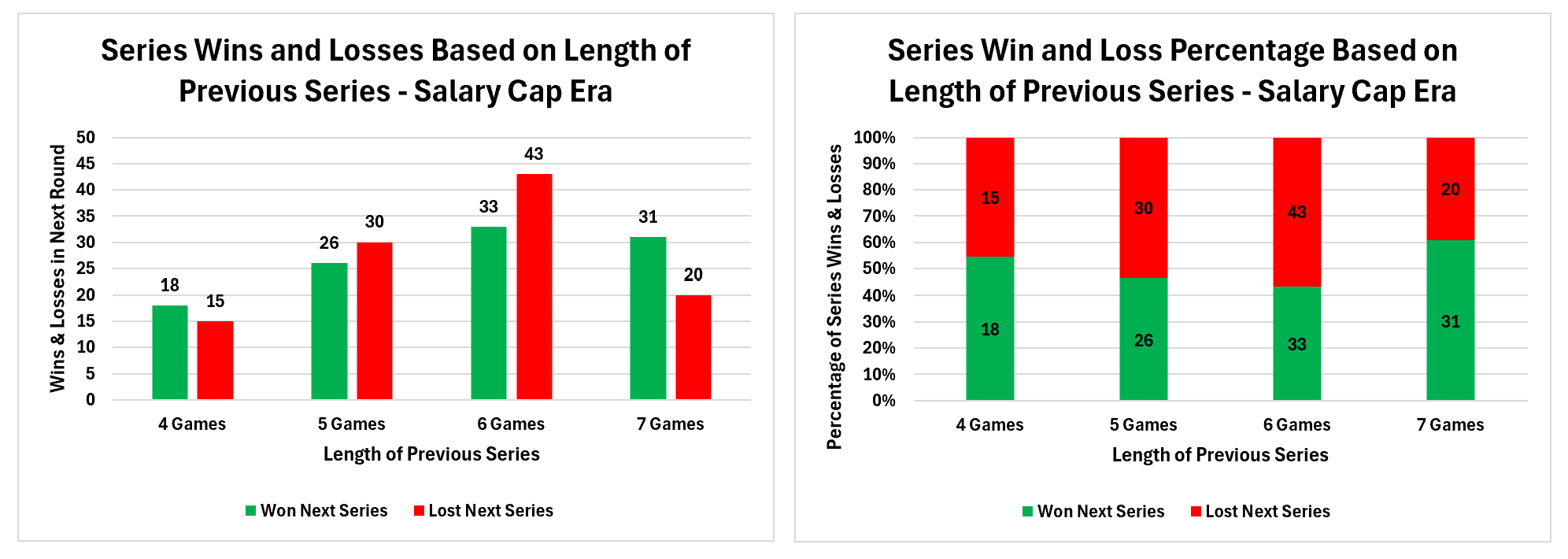
When looking at the numbers, in the salary cap era, teams that win a series in seven games have the best series winning percentage in the next round, with teams winning a series in seven winning the next series 60.8% of the time, not including series where both teams just came out of seven-game series. However, teams that win in four games have the second best win rate in the next series, where they win the next series 54.5% of the time, not including two instances where both teams swept their previous opponent (2011 Bruins vs Lightning and 2018 Golden Knights vs Sharks). However, a confounding variable at play is that teams that achieve sweeps are typically higher seeds and teams that are amongst the best in the league, meaning their series win rate is expected to be high regardless of how much rest they have.
However, looking at when the two extremes meet, this is the ninth instance since the start of the century where a team that swept their previous opponent meets a team that won their previous series in seven games. Of the previous eight instances, the team that won their previous series in seven games defeated the team that swept their previous opponent seven times.
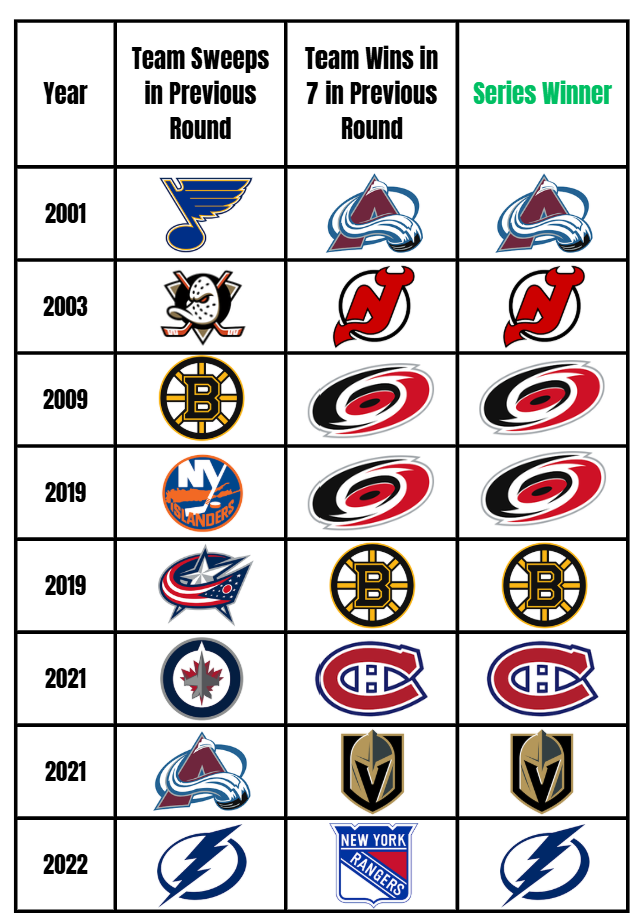
The 2022 Lightning are the only team to buck this trend in this century, where they swept the Florida Panthers in round two and met up with the New York Rangers in the Eastern Conference Finals, who had just defeated the Hurricanes in seven games. Even in this scenario, the Rangers took a 2-0 series lead before the Lightning got their game together and smothered the Rangers defensively to win four games in a row. Otherwise, this trend has shown that teams in a rhythm have significant success against teams with long breaks, and that fatigue is not a concern compared to rust.
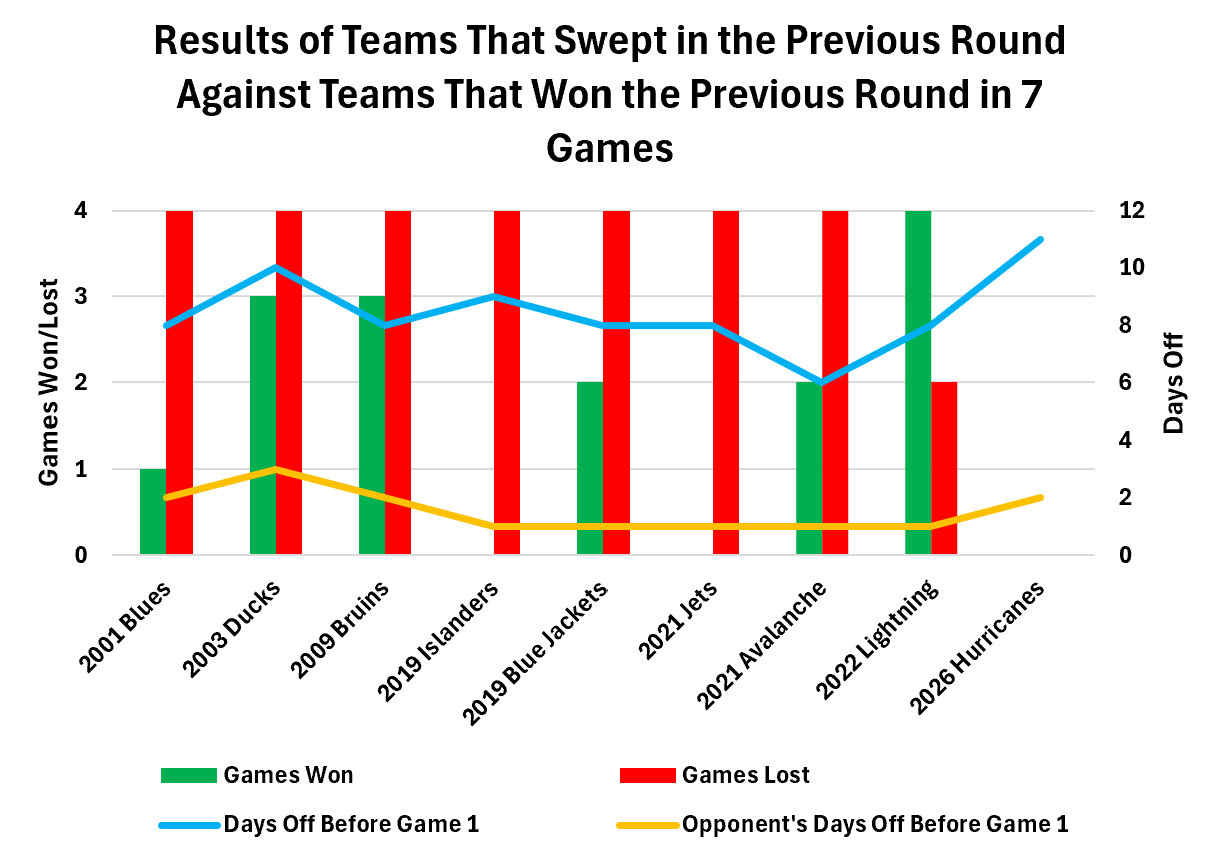
Does this mean that the Hurricanes’ modern-day record of days off between rounds will be detrimental? Not necessarily, as the 2022 Lightning have shown that special teams can overcome the odds. The other important note is that this trend does not have a large sample size, and should be taken with a grain of salt. Rest is one variable at play, however, experience, which might be a topic for another day, is also a significant factor at this stage in the playoffs, in which the Hurricanes have the significant advantage over the Canadiens. But no matter the case, it will not be surprising if the Hurricanes start slower than usual in game 1 of the Eastern Conference Finals after so much time between games.