
How the NHL Regular Season League Standings Correlates to Post-Season Success
The 2025-2026 Stanley Cup Playoffs are under way, and the topic usually brought up ahead of the beginning of any post-season is the topic of the “Presidents’ Trophy curse”. This term was coined from the fact that despite being awarded to the best team in the standings, the Presidents’ Trophy winner hasn’t won the Stanley Cup since 2013 when the Chicago Blackhawks won the Stanley Cup. This was also the only Presidents’ Trophy winner to win the Stanley Cup since 2008. But despite only one Stanley Cup winner among Presidents’ Trophy winners in the last 17 post-seasons, is it valid to label finishing first in the league as a curse? This article will analyze how regular season seeding relates to playoff success, focusing on standings beginning in 1993-1994 when the NHL shifted to the Eastern and Western Conference format. Stats from the 2019-2020 and 2021 Covid seasons will be excluded from this analysis.
Since the 1993-1994 season, no seed in the entire league standings has won the Stanley Cup more often than the Presidents’ Trophy winning first seeds, with six winners.
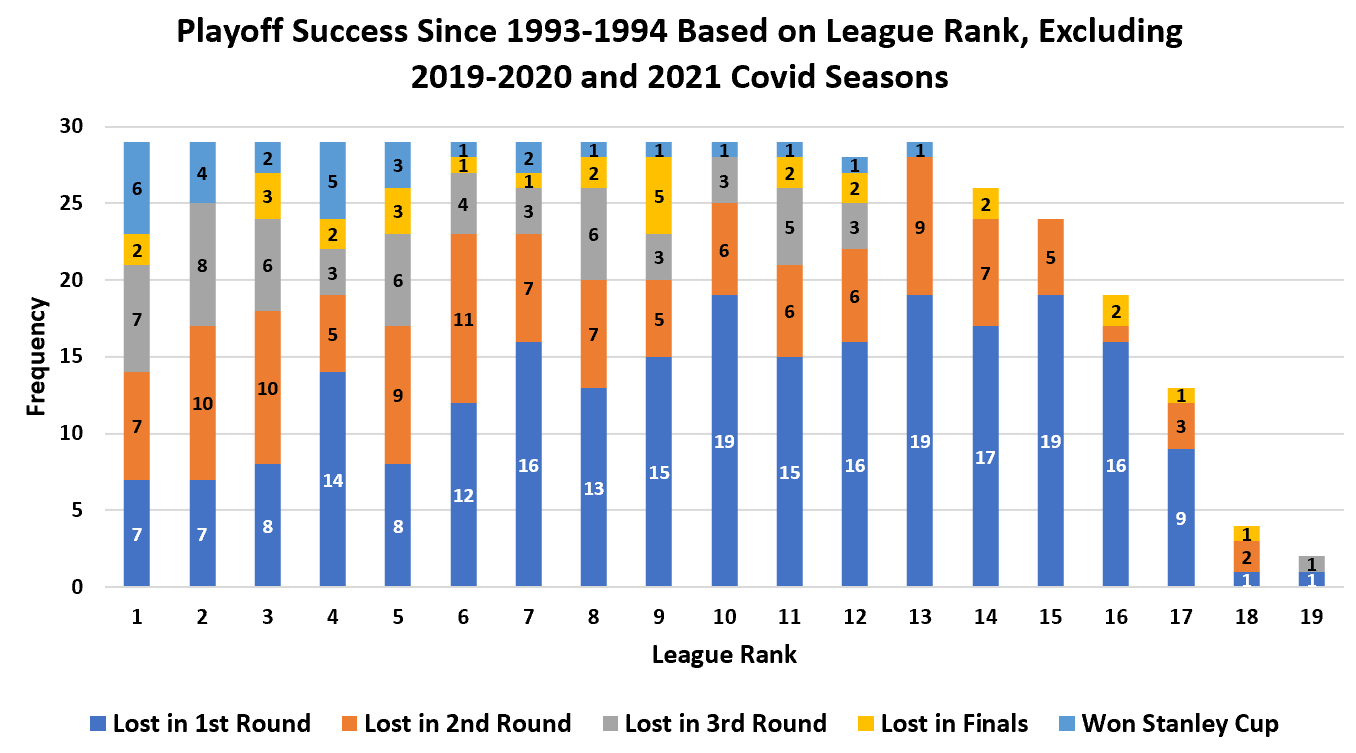
The 4th seed has won the Stanley Cup five times, with the 2nd seed winning the Stanley Cup four times. From the 8th seed to the 13th seed, each seed has had one occurrence of a Stanley Cup champion, with zero occurrences below the 13th seed. In fact, 17 cups have been won by teams finishing in the top four alone, with a combined 12 cups won among all other seeds below the 4th seed. Beyond Stanley Cups, Presidents’ Trophy winners have gone past the second round more often than not, which cannot be said about any other league ranking. Without examining any stats that indicate actual on-ice play, these rankings alone indicate that the top Stanley Cup contenders generally finish higher in the league standings for a good reason.
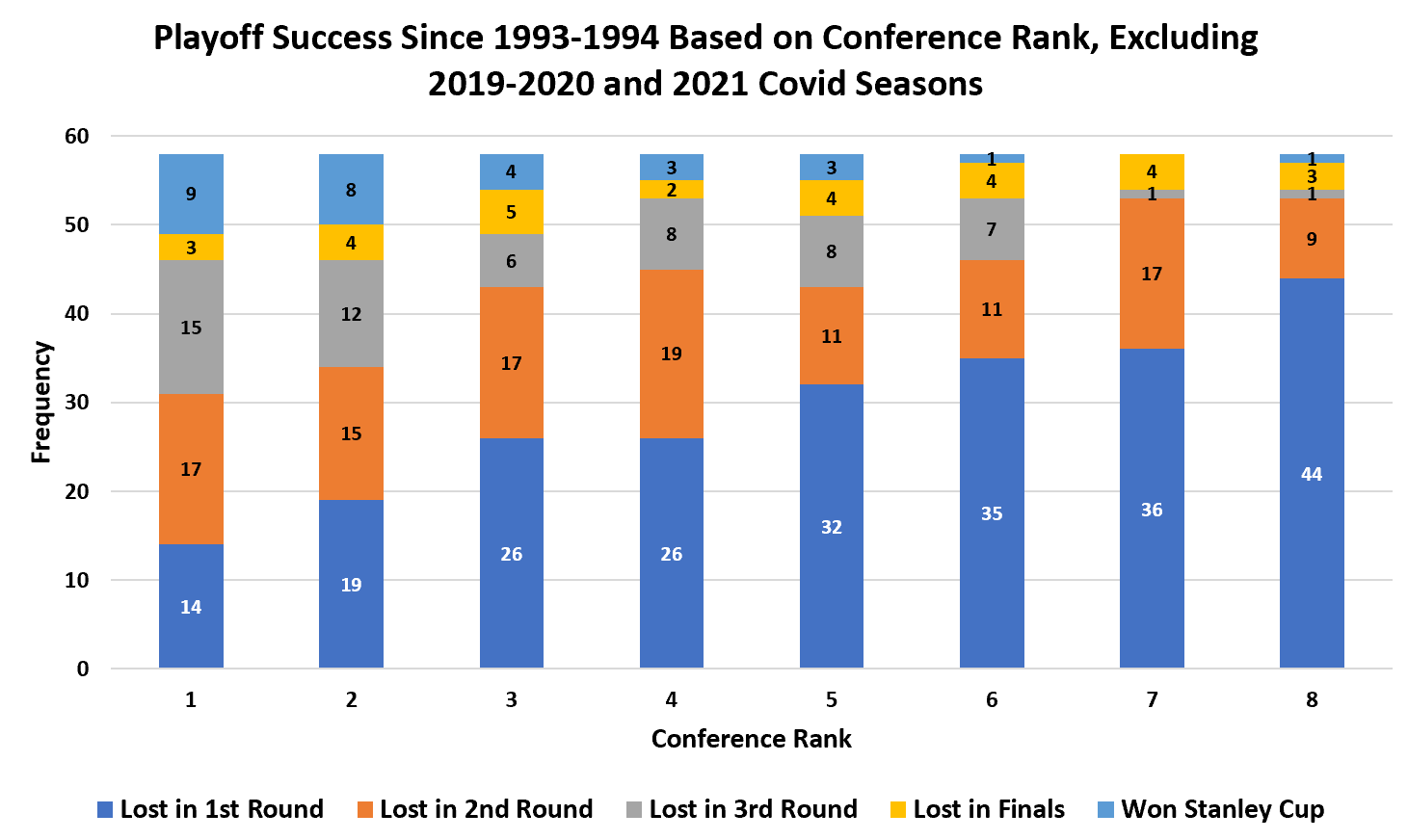
This is also reflected in the conference rankings, where the highest seeds within a conference have won the Stanley Cup more frequently in order until the 7th seed, where no 7th seed has won the Stanley Cup since the 1993-1994 season, whereas an 8th seed has won the cup, when the 2011-2012 Los Angeles Kings became the only 8th seed to win the Stanley Cup. The 2013-2014 Los Angeles Kings are the only 6th seed to win the Stanley Cup in this time span, meaning the Los Angeles Kings are the only franchise since 1993-1994 to win the Stanley Cup finishing below 5th in the conference standings.
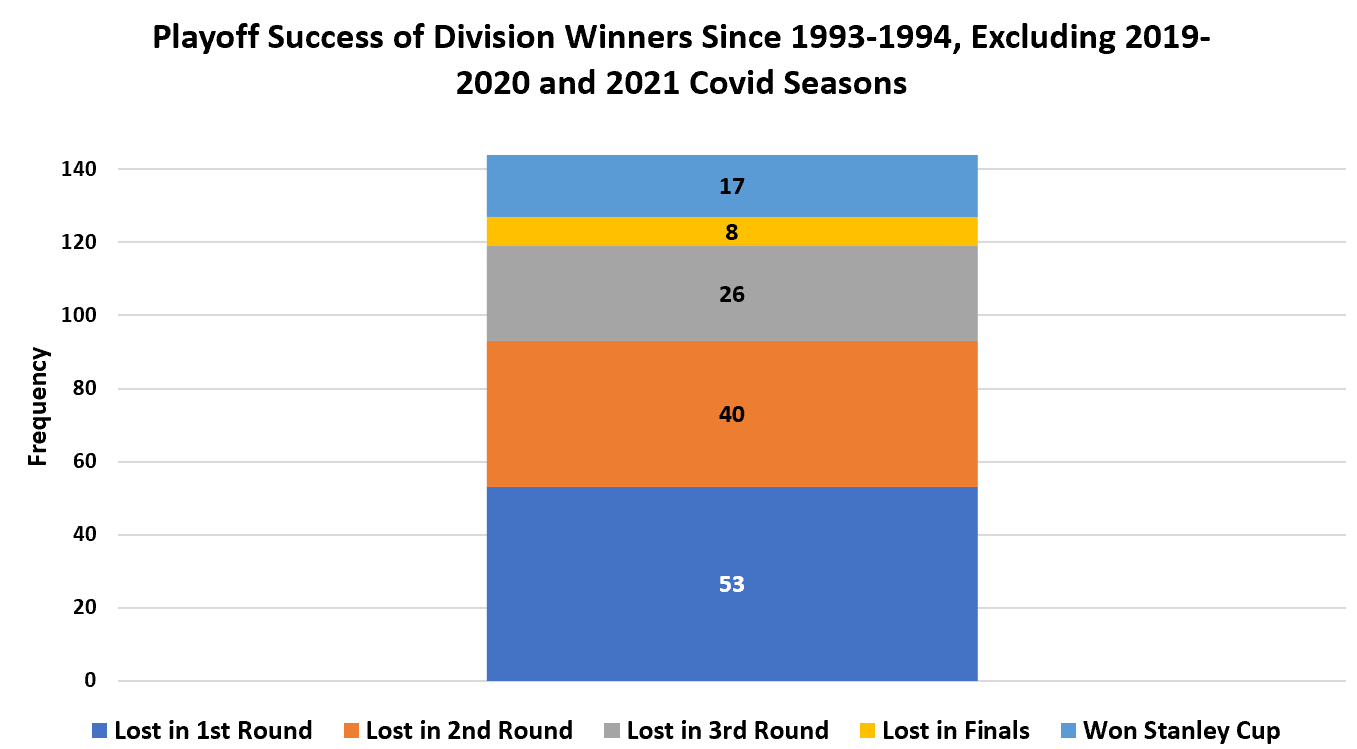
The final consideration of the impact that the standings have on playoff success are division winners, as regardless of league standings, winning the division has implied benefits such as guaranteed home-ice advantage in the first round. Since 1993-1994, there have been 144 division winners, where 91 of them won at least one round for a first round success rate of 63.2%. Division winners have won 17 of the 30 Stanley Cups, which is especially impressive given that the number of division winners have always been outnumbered by the number of non-division winners in the playoffs, and even more so when the NHL uses a four-division format. What is also impressive is that division winners have won 17 out of 25 Stanley Cup Finals, with only five of the 30 finals since 1994, excluding 2020 and 2021, not including a division winner. This is a finals win rate of 68.0%, but that is partly because this metric includes finals where both teams were division winners. The 1995 New Jersey Devils, 2000 New Jersey Devils, and the 2009 Pittsburgh Penguins are the only non-division winners to defeat a division winner in the Stanley Cup Finals.
While this analysis isn’t as insightful or important as analyzing on-ice variables to make predictions based on team performance, this article does serve as a reminder that the regular season does matter, and often indicates which teams will likely have the most success. In recent years, there has been common talks about how parity in the NHL is increasing, and that nothing in the regular season matters once the playoffs start. However, the numbers say otherwise. The best teams in the regular season generally go the farthest in the playoffs, and teams finishing in the bottom half of the conference are far more unlikely to win the Stanley Cup. As a result, the fact that a Presidents’ Trophy team hasn’t won the Stanley Cup since 2013 is more so a coincidence, or at most a psychological impact.