
Stanley Cup Champions That Missed the Playoffs the Next Season
As we begin March of 2026 and approach the NHL trade deadline, each team has between 20-25 games remaining in the regular season. Of the many teams in the Eastern Conference wild card race trying to miraculously push into a playoff spot, the Florida Panthers are one of the most notable, as they are currently 8 points back of the Boston Bruins for the second wild card spot, with the Panthers having one less game remaining in the season. Having won the last two Stanley Cups, having won three consecutive Prince of Whales trophies as the Eastern Conference finalist, and having won the 2021-2022 Presidents’ Trophy as the league’s best team in the regular season, missing the playoffs was not something that many imagined would happen to the Florida Panthers heading into the 2025-2026 NHL season. Not only is it an unlikely feat to gain 8 points on the Bruins, but they would also need to surpass four other teams in front of them in line for the second wild card spot. While key injuries have not helped the Panthers this season, namely injuries to Aleksander Barkov, Matthew Tkachuk, and Seth Jones, the largest issue has been their goaltending. Sergei Bobrovsky has declined tremendously, and the Panthers’ .874 save percentage is second worst in the NHL, only better than the Ottawa Senators. While it is rare to see a defending Stanley Cup Champion miss the playoffs, it has occurred five times before. As we wait to see if the Panthers can pull off a miraculous turnaround in their last 22 games, let’s look back at past Stanley Cup Champions who missed the playoffs the next season, focusing on the expansion era beginning in 1967.
2014 Los Angeles Kings
The mid-2010s Los Angeles Kings were one of the most difficult teams to score on in the NHL. In 2011-2012, the Kings finished with the second fewest goals allowed, and would maintain their ability to keep pucks out of their net on the back of goaltender Jonathan Quick to win their first Stanley Cup in franchise history. In 2013-2014, the Kings allowed the fewest goals against in the regular season and won their second Stanley Cup in three seasons.
However, in the following season, the Kings would finish 9th in the Western Conference, missing the playoffs with 95 points, 4 points back of the second wild card spot. The Kings did not particularly slump, they were more so passed by other strong teams, as missing the playoffs with 95 points was 1 point shy of tying an NHL record for most points in a season and not qualifying for the playoffs. The Kings also maintained strong defence and goaltending, finishing 7th in goals against with goaltender Jonathan Quick recording a .918 save percentage. However, the Kings won 40 out of 82 games, with a lot of their points coming from extra time losses. Had they won a third of these extra time games that they lost, they would have qualified for the playoffs. The Kings also made a strong push in February, going on an eight game winning streak to turn a concerning 21-18-12 record into a respectable 29-18-12 record. However, this push was not enough, and the Kings would not be able to defend their title in the 2015 Stanley Cup Playoffs.
The Kings would bounce back the following season in 2015-2016, but would eventually trail off into a re-tool in the late 2010s and early 2020s.
2006 Carolina Hurricanes
The 2005-2006 season might have been one of the most unique seasons in NHL history, and understandably so. The NHL had gone through its first complete lockout in 2004-2005, and significant rule changes were made to the league. The most notable changes were the implementation of the salary cap and adjusting the size of the neutral zone, but there were also subtle changes, like a change to how referees would call the game with significantly more minor penalties being called. All this to say, the NHL hadn’t played any games in over a year and entered a new era, which meant a much more unpredictable season was coming.
Despite missing the playoffs in the two seasons prior, the Carolina Hurricanes had a dominant 2005-2006 season, finishing 4th in the league standings, 2nd in the Eastern Conference, and ultimately winning the Stanley Cup. They were especially deep offensively, and also had a solid defensive unit that worked well as a group. Despite goaltending on paper being their biggest question mark, rookie goaltender Cam Ward would end up winning the Conn Smythe Trophy as playoff MVP. However, not only did the Carolina Hurricanes miss the playoffs the following season in 2006-2007, but they would also become what is so far the only team in NHL history to miss the playoffs in two consecutive seasons after winning the cup, as they did so again in 2007-2008.
But focusing on the season after, the Hurricanes missed the playoffs by 4 points and would place 11th out of 15 teams in the East with 88 points. Goaltending would be an issue for the Hurricanes, as both Cam Ward and John Grahame posted mediocre .897 save percentages. Depth up front was also an issue, as despite a fantastic top six core, points were hard to come by from their depth. Their defence was also not as effective as the prior season. Mike Commodore led the backend with just 29 points in 82 games. Frantisek Kaberle, who played a major role on the team the prior season with 44 points in 77 games, and 13 points in 25 games in the post-season, including the Stanley Cup-winning goal, had just eight points in 27 games played with the team in 2006-2007. This may also be related to a shoulder injury, as he had missed the entire season up until February 6, 2007 before returning.
What also proves the 2005-2006 season to be a one-of-a-kind season is that the opposing finalist, the Edmonton Oilers, also missed the playoffs the prior season and the next season, and is the only instance in NHL history where both finalists missed the playoffs the next season.
1995 New Jersey Devils
The 1995 New Jersey Devils won the Stanley Cup in the lockout-shortened season. Despite finishing 5th in the East with a record of 22-18-8, the 1995 Devils would become one of the most dominant playoff teams the league has ever seen, losing just four games in the entire post-season. The Devils winning the Stanley Cup in 1995 was not as surprising as it sounds, as despite their mediocre regular season record, the Devils had finished 2nd in the league the prior season and were just an overtime goal away from going to the Stanley Cup Finals.
Fast forward to the 1995-1996 season, and despite adding new faces such as Petr Sykora, Phil Housely, and Dave Andreychuk, the New Jersey Devils would miss the playoffs by just 2 points. What is more devastating is that the Devils were not bad league-wide, finishing 12th out of 26 teams. It’s just that the Eastern Conference was much deeper than the West in 1995-1996, where 12th in the league was also 6th in the division and 9th in the East for New Jersey. The Devils even had a positive goal differential of +13, while the 8th seeded Tampa Bay Lightning had a negative goal differential of -10.
The New Jersey Devils were known to be a fantastic defensive team that prioritized conservative hockey in the era when they won three Stanley Cups, and that was portrayed perfectly in the 1995-1996 season. The Devils finished 2nd last in goals for, scoring just 215 goals, while simultaneously finishing 2nd best in goals against, allowing just 202 goals. Unlike the 2006-2007 Carolina Hurricanes, the Devils had tremendous depth down the lineup, with 12 different players recording at least 20 points. For them, they were missing top end talent, as Steve Thomas led the team with just 61 points in 81 games played. The Devils also had a middling December, going 4-9-1, and after a 7-3-1 January, the Devils did not have good enough performances in February, March, or April to make up for their poor start to the season.
The Devils would bounce back and would qualify for the Stanley Cup Playoffs for the next 13 seasons, winning two more Stanley Cups along the way, before finally missing the playoffs again in 2011. The 1995-1996 Devils was a bizarre case of a defending Stanley Cup Champion being significantly impacted by playing in an inordinately tough conference, which is similar to what the Florida Panthers are facing this season when comparing the strength of the East to the West.
1969 Montreal Canadiens
We have to go all the way back to 1970 before seeing the next defending cup champion miss the playoffs. This time, it was the Montreal Canadiens. The Montreal Canadiens are well known for their dynasty in the 1970s, where they won four Stanley Cups from 1976-1979, and two Stanley Cups in the first half of the decade. They were also dominant in the mid to late-1960s, with Stanley Cups in 1965, 1966, 1968, and 1969. However, something to note about 1968 and 1969 specifically is that those two seasons featured very good teams missing the playoffs. This is because the NHL expanded from six teams to 12 teams, with the original six being in one division, and the six expansion teams being in a new division called the West Division. Because only the top four teams from each division made it to the playoffs, both of those seasons featured two original six teams automatically missing the post-season, despite being far superior to any of the six expansion teams.
The same dynamics followed in 1970, where the Montreal Canadiens would finish 5th despite having 6 more points than the St. Louis Blues, who were the 1st place team in the West Division. The Canadiens’ season actually came down to the final day of the regular season, and despite having probable odds to make it to the playoffs, everything that could go wrong on that last day did go wrong, and Montreal fell short by exactly three goals. The full context of the ending to the 1969-1970 season is talked about in depth in a previous post, but long story short, the first tie-breaker procedure at the time being goals for caused the 1969 champions to miss the playoffs the following year.
What’s even more amazing is that the Montreal Canadiens hold two of the top six records for the longest playoff streaks in NHL history; 21 years from 1948-1949 to 1968-1969, and 24 years from 1970-1971 to 1993-1994. Had they just scored three more goals at some point in the 1969-1970 regular season at minimum, they would have had a mega-streak of 46 consecutive playoff appearances, which would have been an NHL record unlikely to ever be broken.
There isn’t much to critique about the 1969-1970 Montreal Canadiens. They put up a 38-22-16 record and were simply passed by four of the other original six teams. Because Toronto was the other original six team to miss the playoffs, this would end up being the last time there were no Canadian teams in the post-season for 46 years until 2016 broke that streak.
1967 Toronto Maple Leafs
A lot of what was said about Montreal in 1970 can be repeated here for the Toronto Maple Leafs when they were defending their 1967 title in the 1967-1968 season. This was the first season of the expansion era, but ironically, the Leafs actually performed worse against the expansion teams, going 10-11-3 against them compared to a 23-20-7 record against their own division.
The Maple Leafs would finish 5th in the division, ahead of only the Detroit Red Wings and behind the Chicago Blackhawks by 4 points.
While the Maple Leafs would remain competitive in the 1970s, they would never see the same dominance that they had with their four Stanley Cup wins in the 1960s, making 1967 the last time the Maple Leafs have been to the Stanley Cup Finals to this day.
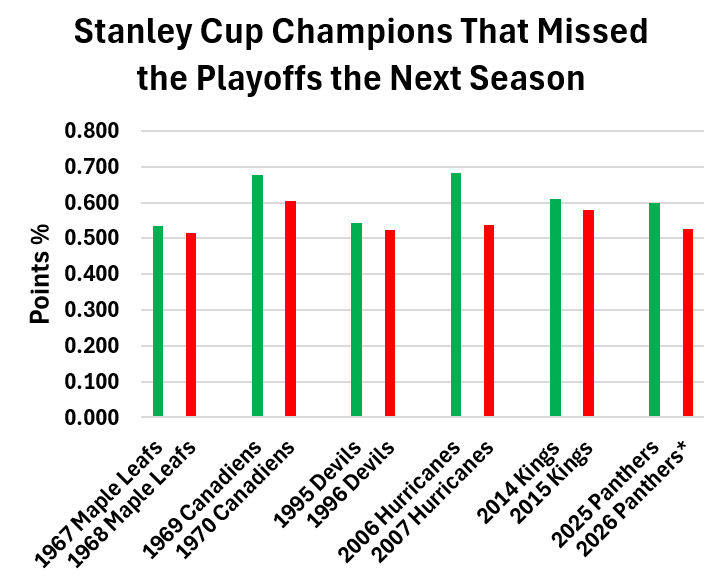
With the 2025-2026 Florida Panthers being 8 points back of the playoff line with only 22 games remaining, they currently have just a 5.8% chance to make it to the playoffs as of March 1, 2026, according to moneypuck.com. When the hockey world discussed the possibility of a Florida Panthers’ “three-peat” heading into this season, the conversation was often focused on which team would be capable of defeating them in a seven-game playoff series. Despite significant injuries, very few of us could have imagined the Florida Panthers completely missing the playoffs in 2026.